How Do Bitcoin ATMs Work? A Beginner’s Guide
TL;DR Bitcoin ATMs let you buy cryptocurrency with cash or sell crypto for cash, but they work nothing like regular ATMs. You scan a QR code from your wallet, insert cash, and the machine sends Bitcoin directly to your address. Fees run high (often 10-20%), and you'll need to verify your identity for larger amounts. They're convenient for quick purchases, but online platforms usually offer better rates.
Do you remember when you first used an ATM? If you can, the buttons and screen probably made sense after the first try. Bitcoin ATMs follow a similar flow, just with cryptocurrency instead of checking accounts.
These machines are spreading fast - over 30,000 worldwide now - yet many crypto users still haven’t tried one. Here's how they actually work and whether they're worth the premium you'll pay for convenience.
What You'll Learn in This Guide
→ What Bitcoin ATMs actually are - These aren't bank ATMs. They're cash-to-crypto kiosks run by private operators.
→ The step-by-step buying process - From finding a machine to getting Bitcoin in your wallet in under 10 minutes.
→ The real cost of convenience - Why fees hit 10-30% and what you're actually paying for.
→ When they make sense (and when they don't) - The few situations where the premium is justified versus when you're just throwing money away.
→ How to avoid getting scammed - The $333 million problem and red flags that scream "walk away now."
What Is a Bitcoin ATM?
A Bitcoin ATM is a physical kiosk that lets you exchange cash for cryptocurrency or sell crypto for cash. Despite the name, it doesn't connect to any bank account and won't dispense Bitcoin in physical form (because obviously that's not a thing).
You might also see them called Bitcoin Teller Machines or Crypto Teller Machines, though most people just say Bitcoin ATM regardless of what cryptocurrencies they support.
The machine acts as an intermediary between you and a cryptocurrency exchange. You provide cash and a wallet address, and it handles the transaction on the backend through its internet connection. Some machines are one-way (buy only), while others are two-way (buy and sell).
These aren't owned or operated by banks. Private companies like CoinFlip, Bitcoin Depot, and CoinCloud run them, which explains why fees vary wildly between operators and locations.
You'll find them tucked into convenience stores, gas stations, shopping malls, and airports. The interface walks you through the process step by step, though the exact flow depends on who operates the machine.
Bitcoin ATMs By the Numbers
Around 39,000 Bitcoin ATMs operate worldwide as of early 2026, up from roughly 37,700 at the start of 2025. That's about four new machines going live every day, though the growth has slowed compared to the boom years of 2021-2022.
The USA dominates with over 30,000 machines, representing about 80% of the global total. Canada comes in second, followed by Australia, which saw one of the fastest growth rates in 2025 with over 600 new installations. Europe has been slower to adopt, with only around 1,760 machines across the continent.
General Bytes and Genesis Coin manufacture most of these machines, controlling roughly 60% of the market between them. On the operator side, companies like Bitcoin Depot, CoinFlip, and CoinCloud run the largest networks, with Bitcoin Depot alone managing over 7,000 locations across North America.
How Do Bitcoin ATMs Work?
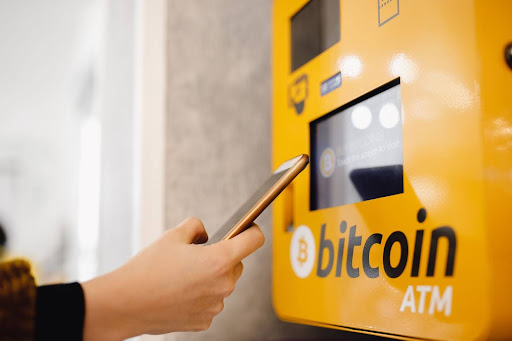
Bitcoin ATMs don't hold any cryptocurrency. They're essentially internet-connected terminals that connect you to a cryptocurrency exchange in real time.
When you insert cash, the machine contacts the exchange through its internet connection, purchases Bitcoin at the current rate (plus fees), and sends it directly to your wallet address. The transaction happens immediately at the machine, though you might not see the coins in your wallet for a few minutes while the backend processes everything and the blockchain confirms the transfer.
The machine verifies your identity through various methods depending on the amount. Small purchases might only need a phone number, while larger transactions require ID verification through the built-in scanner and camera.
Two-way machines work similarly in reverse. You send Bitcoin from your wallet to an address the machine generates, wait for blockchain confirmation, and then collect your cash. The operator's exchange sells your Bitcoin, and the machine dispenses the equivalent amount minus fees.
These machines need to comply with financial regulations, which is why most require some form of identity verification. Operators register as money service businesses and follow anti-money laundering rules, just like currency exchange kiosks at airports.
How to Use a Bitcoin ATM - Step by Step
We’re going to keep this simple because it actually is.
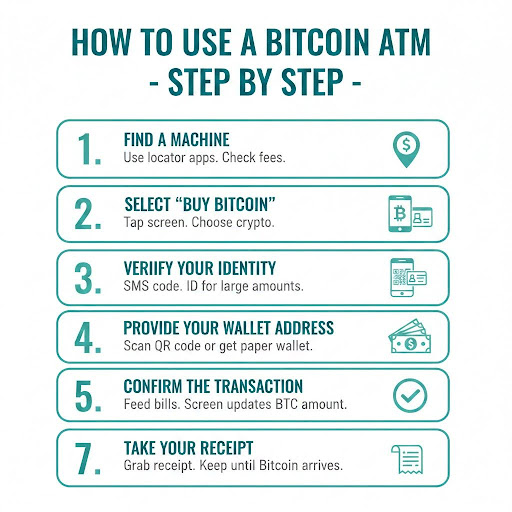
The Buying Process
1. Find a Machine
Use Coin ATM Radar or similar locator apps to find nearby machines. These apps show what cryptocurrencies each machine supports, current fees, and whether they're operational. Check the posted fees before you start - they should be displayed on the machine or available in the app.
2. Select "Buy Bitcoin"
Tap "Buy Bitcoin" on the touchscreen, or choose whichever cryptocurrency you want. Many machines offer support for Bitcoin and Ethereum, though some also support additional coins.
3. Verify Your Identity
Every transaction requires a phone number with SMS verification. You'll receive a code via text that you enter on the screen. Purchases over $500-$1,000 (the threshold varies by operator and location) trigger additional requirements like ID scanning and sometimes a photo. Privacy levels depend entirely on the operator and local regulations.
4. Provide Your Wallet Address
Scan the QR code from your existing wallet app. If you don't have a wallet, some machines can generate a paper wallet - basically printed QR codes representing your new wallet. Keep this paper safe, because it's your only way to access those funds until you import it into a proper wallet app.
5. Insert Your Cash
Feed bills one at a time into the bill validator. The screen updates to show how much Bitcoin you'll receive based on the current exchange rate plus fees. Transaction limits typically range from $100 to $10,000, though this varies by operator.
6. Confirm the Transaction
Review the details and hit confirm. The machine processes the transaction immediately, though the Bitcoin might not appear in your wallet for a few minutes while the backend processes everything and the blockchain confirms the transfer.
7. Take Your Receipt
Grab the printed receipt with your transaction details and ID. Keep it until the Bitcoin shows up in your wallet.
The Selling Process (Two-Way Machines)
Select "Sell Bitcoin" on the screen and complete the same identity verification steps.
The machine generates a QR code showing its receiving address. Send the specified amount of Bitcoin from your wallet to that address, making sure you send exactly what it requests.
Wait for blockchain confirmation. Once confirmed, the machine dispenses your cash.
Bitcoin ATM Fees and Costs
This is where Bitcoin ATMs lose most people. The fees are steep, and they're structured in ways that aren't always obvious upfront.
What You'll Actually Pay
Most Bitcoin ATMs charge between 10% and 25% in total fees when you buy. Some machines hit 30% or more. Compare that to online exchanges where fees typically run under 1%, and you start to see why these machines are controversial.
The fee structure usually breaks down into two parts:
The transaction fee shows up clearly on the screen before you confirm. This typically runs 8-20% and covers the operator's costs for running the machine, maintaining cash liquidity, and staying compliant with regulations.
The spread is sneakier. This is the markup between the actual market price of Bitcoin and what the ATM charges you. If Bitcoin trades at $100,000 on exchanges but the ATM prices it at $108,000, that's an 8% spread built into the rate. Many users miss this entirely because it looks like the normal price fluctuation.
Some machines also tack on a flat network fee ($1-$6) to cover blockchain transaction costs.
Buy $500 worth of Bitcoin at a machine charging 15% total fees, and you walk away with around $425 in actual Bitcoin. That's $75 gone just for the convenience of using cash at a kiosk.
Selling fees tend to be lower, usually 4-10%, though some operators charge the same rate for both buying and selling.
Why So Expensive?
The fees aren't arbitrary. Running these machines costs real money.
Cash handling is expensive. Operators need to stock machines with cash for two-way units, collect bills from buy-only machines, transport it securely, and manage the risk of theft or mechanical failure.
Regulatory compliance isn't cheap either. Bitcoin ATM operators register as money service businesses and follow anti-money laundering rules. That means customer verification systems, transaction reporting, and staying current with changing regulations across different states.
Liquidity costs. Operators need to maintain enough Bitcoin inventory to fill purchase orders instantly, which means holding crypto that fluctuates in value. They price in a buffer to protect against sudden price drops between when you insert cash and when the transaction settles.
Location fees add up. High-traffic spots like airports, malls, and busy convenience stores charge rent or take a cut of each transaction. Machines in prime locations pass those costs to users.
The machines themselves aren't cheap - hardware, internet connectivity, maintenance, and security all cost money to keep running.
The Convenience Tax
Bitcoin ATMs charge what they do because they offer something exchanges can't: instant access with cash and minimal friction. No bank account needed, no waiting for verification, no multi-day transfer delays. You get Bitcoin in minutes.
That convenience comes at a price. For someone who needs crypto immediately or doesn't have access to traditional banking, the premium might be worth it. For regular purchases or larger amounts, the fees quickly become absurd.
Pros and Cons of Bitcoin ATMs
Pros | Cons |
✔ Instant access - Buy Bitcoin in minutes with cash, no waiting for bank transfers or exchange verification | ✘ Extremely high fees - 10-30% total costs compared to under 1% on most exchanges |
✔ Cash-friendly - No bank account or credit card required | ✘ Limited transaction amounts - Daily limits typically $1,000-$10,000 depending on operator and state |
✔ Privacy for small amounts - Low-value purchases often only need a phone number | ✘ Reduced privacy for larger purchases - ID scanning and photo verification required over certain thresholds |
✔ No exchange account needed - Skip the signup process, email verification, and KYC paperwork | ✘ Irreversible transactions - Send to the wrong address, and your money is gone forever |
✔ Widespread availability - Over 30,000 machines globally in convenient locations | ✘ Cash only (mostly) - Very few accept debit cards, almost none take credit cards |
✔ Two-way functionality - Some machines let you sell Bitcoin for cash on the spot | ✘ Potential for scams - Fraudsters target Bitcoin ATM users, particularly older adults |
When Bitcoin ATMs Make Sense
Bitcoin ATMs work best for specific situations where their strengths outweigh the cost. If you need cryptocurrency immediately and can't wait for exchange transfers to clear, the premium might be justified.
The same goes for people without bank accounts who rely on cash transactions.
Small experimental purchases make sense too - spending $50 to test the process and see how Bitcoin works costs you about $7.50 in fees, which is tolerable for education.
Some users value the privacy aspect for smaller transactions. While you'll still need to provide a phone number, you can avoid linking bank accounts or credit cards to crypto purchases. That level of separation appeals to people who want to keep their financial activities compartmentalized.
When They Don't
The fees become ridiculous for regular purchases or larger amounts. Someone buying $5,000 worth of Bitcoin weekly would lose $750-$1,500 per transaction to fees. Over a year, that's anywhere from $39,000 to $78,000 just handed to the machine operator. At that scale, the few hours it takes to set up an exchange account and link a bank account pays for itself immediately.
Bitcoin ATMs also create a perfect environment for scammers. The irreversible nature of cryptocurrency, combined with machines that accept cash, makes them attractive targets for fraud schemes.
Safety Tips and Scam Awareness
Romance scams, fake tech support, and government impersonation schemes frequently direct victims to Bitcoin ATMs. Scammers notched $333 million from Bitcoin ATM scams in 2025, according to the FBI. Older adults get hit particularly hard, with people over 60 accounting for a disproportionate share of losses.
Common Scam Tactics
Impersonation scams involve someone claiming to be from the IRS, police, utility companies, or your bank. They create urgency and fear, demanding immediate payment via a Bitcoin ATM to resolve a supposed problem. Remember that legitimate organizations never demand Bitcoin ATM payments.
Romance and investment scams build trust over time. Someone you met online asks you to deposit money at a Bitcoin ATM, either for an "emergency" or to fund an "investment opportunity" with promised returns that never materialize.
Tech support scams start with fake warnings that your computer is compromised. The scammer walks you through "fixing" the problem, which somehow requires paying at a Bitcoin ATM. They often use remote access software to increase pressure and make the threat seem real.
Staying Safe
Never send cryptocurrency to someone you don't know in person.
Ignore anyone demanding Bitcoin ATM payment, especially if they're creating urgency.
Verify the machine's legitimacy by checking the operator's website - reputable operators clearly identify themselves.
Use an established wallet app rather than relying on paper wallets from the machine. If you do get a paper wallet, transfer the funds to a secure wallet immediately and keep the paper private until then.
Start with a small test transaction if you're using a machine for the first time. Be aware of your surroundings when handling cash, and don't let anyone "help" you complete the transaction or see your wallet information.
Bitcoin ATMs vs. Other Purchase Methods
Bitcoin ATMs are only one way to buy crypto, and they sit at the convenience end of the spectrum.
Method | Fees | Speed | Privacy | Best For |
Bitcoin ATM | ~10–20% | Near-instant | Limited | Small cash purchases, urgency |
Exchange | ~0.5–1.5% | Minutes to hours | Low | Regular buys, larger amounts |
Peer-to-peer | ~0–2% | Varies | Medium | Privacy, alternative payments |
Brokerage apps (Cash App, PayPal) | ~1–2.5% | Instant | Low | Beginners, simple setup |
Are Bitcoin ATMs Worth Using?
To be honest, in most cases, you should stay away from Bitcoin ATMs. The fees are brutal, the scam risk is real, and online exchanges offer better rates with more security features. For regular crypto purchases or any large amount, the premium just doesn't make sense.
That said, if you're a crypto nerd like us, using a Bitcoin ATM might be something you are curious about and want to cross off your list. The experience is interesting from a technology standpoint, and there's something satisfying about the instant cash-to-crypto conversion. Try it once with a small amount just to see how it works.
For everyone else, Bitcoin ATMs work best as a backup option. Need crypto immediately and can't wait for an exchange transfer? Fine.
Don't have access to traditional banking? They serve a purpose.
But as your primary way to buy Bitcoin? You're paying way too much for convenience.
Ready to Learn More About Crypto?
Bitcoin ATMs are just one small piece of crypto with no great importance. If you want to understand how crypto actually works, what tokens are worth paying attention to, and how to not get ripped off, LearningCrypto has you covered.
Get instant answers about any token or protocol through our AI chat assistants. Track your portfolio across multiple chains with professional tools. Access real-time market data and on-chain analytics that show you what's actually happening beyond the price charts.
Our team shares exactly what we're holding and why, backed by years of experience building and investing in this space.
FAQs
How do crypto ATMs work?
A crypto ATM connects cash or a debit card to the blockchain. You scan a wallet QR code, insert money, and the machine sends crypto directly to your wallet. There’s no account balance to check and no bank involved. It’s more like a guided cash-for-crypto swap than a traditional ATM.
Can you buy other cryptocurrencies besides Bitcoin?
Yes. While Bitcoin is available on every machine, many also support additional cryptocurrencies. Ethereum and Litecoin are the most common additions, with Bitcoin Cash also widely available. Some machines support Dogecoin or stablecoins like USDT and USDC. Check the screen when you arrive to see which cryptocurrencies are available at that specific machine.
What happens if the transaction fails?
Keep your receipt - it has the transaction ID and customer support contact information. If your cash was accepted but Bitcoin never arrived, contact the operator immediately with your transaction details. Reputable operators will investigate and resolve the issue, though response times vary.
Are Bitcoin ATM fees the same everywhere?
No. Fees vary wildly by operator and location. You might find machines charging 8% in one location and 25% two blocks away, run by a different company. High-traffic locations like airports and tourist areas typically charge more than machines in regular neighborhoods.
Can I use a Bitcoin ATM anonymously?
Not really, at least not for any meaningful amount. You'll need to provide a phone number for SMS verification on virtually every transaction, which already ties the purchase to you. Anything over a few hundred dollars requires government ID scanning. Some states have implemented even stricter requirements. If true anonymity is your goal, Bitcoin ATMs aren't the answer.
Can I buy Bitcoin with loose change or small bills?
Most machines accept bills starting at $1, so technically yes. However, the flat network fees (usually $1-$6 per transaction) plus the percentage-based operator fees make tiny purchases economically pointless. Buying $5 worth of Bitcoin might cost you $2-$3 in total fees.

Cryptocurrency Education
Made Easy
Cryptocurrency Education
Made Easy
Cryptocurrency Education
Made Easy
Secure your edge: Get Crypto Made Easy PDF + weekly insights—free today.
No spam, unsubscribe at any time. By subscribing, you agree to our Privacy Policy. Need to unsubscribe? Unsubscribe from newsletter.
Disclaimer: This article is for educational purposes only and does not constitute financial advice. Cryptocurrency investments carry risk; you should always do your own research before making any investment decisions.