How to Create Your Own Cryptocurrency
 by Heidi Chakos
"Can I really create my own cryptocurrency?"
Yes. You can have a live, tradable token in under ten minutes for less than the price of a coffee. Your cat, your inside joke, your half-baked DeFi idea. All live and tradable before lunch.
The problem? Creating a token and creating something valuable are two completely different sports.
The world doesn't need another shitcoin. But if you're going to create a cryptocurrency, at least do it right.
Token creation takes five minutes and costs under $5. The hard part is everything after: tokenomics that don't implode, legal compliance that keeps you out of federal crosshairs, security that protects your holders, and a community willing to stick around past week two.
CoinGecko data from early 2026 shows that 53% of all tokens launched since 2021 are now defunct. 11.6 million tokens failed in 2025 alone. The crypto graveyard is enormous, and it's mostly filled with projects that nailed the "launch" part and forgot about everything else.
What You’ll Learn
→ Why you don't need coding skills to create a cryptocurrency token
→ The difference between a coin and a token, and why it matters for your wallet
→ Three real ways to launch a token, from $2 meme coins to $50K+ custom builds
→ Where most projects actually fail ( it's not the tech)
→ How to design tokenomics that don't implode on contact with the market
→ Whether you should even do this in the first place
Coin vs. Token

If you're new to blockchain basics, the coin/token distinction trips up a lot of people. They're not the same thing, and knowing the difference saves you from choosing the wrong (and much more expensive) path.
What's a Coin?
A coin runs on its own independent blockchain. Bitcoin has the Bitcoin network. Ethereum has the Ethereum network. Solana has its own chain.
Coins are the native currency of their blockchain, used to pay transaction fees and secure the network. Building one means constructing and maintaining an entire blockchain from scratch.
What's a Token?
A token is built on top of someone else's blockchain. USDC runs on Ethereum (and other chains). Uniswap's UNI token lives on Ethereum. Most meme coins are tokens on Solana.
Tokens use the existing blockchain's infrastructure, can represent an asset, utility, or right, and are dramatically simpler and cheaper to create.
Which Should You Choose?
Feature | Coin | Token |
Own blockchain? | Yes | No |
Difficulty | Very high | Low to medium |
Cost | $50K–$500K+ | $2–$10K |
Best for | New blockchain technology | Projects, apps, communities |
The answer for 99% of people reading this: create a token.
Only consider building a coin if you're developing genuinely new blockchain technology, have a budget north of $500K, and employ a technical team capable of maintaining network infrastructure.
Even billion-dollar projects like USDC and Chainlink are tokens, not coins.
Three Ways to Create a Token
The right approach depends on your goals, budget, and technical comfort. Not your ego.
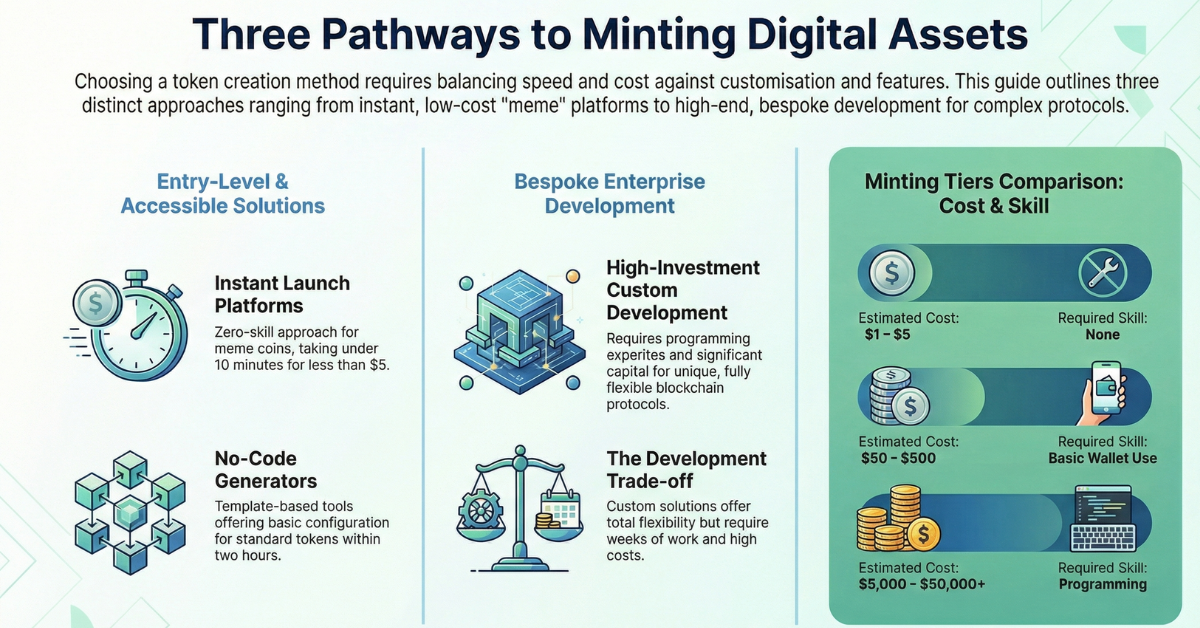
Option 1: Instant Launch Platforms
Time: 5–10 minutes | Cost: $1–5 | Skill: None | Best for: Meme coins, experiments | Trade-off: Zero customization
Option 2: No-Code Generators
Time: 30 minutes to 2 hours | Cost: $50–500 | Skill: Basic wallet use | Best for: Standard tokens with some configuration | Trade-off: Template-based, limited features
Option 3: Custom Development
Time: Days to weeks | Cost: $5,000–$50,000+ | Skill: Programming (or hire developers) | Best for: Complex protocols with unique features | Trade-off: Expensive but fully flexible
Instant Launch Platforms
How These Work
Platforms like Pump.fun on Solana let you create a token with a few clicks. They handle the smart contract deployment, initial liquidity, and exchange listing automatically. Since launching in January 2024, Pump.fun alone has generated over 11.9 million tokens and more than $800 million in revenue. The cost to launch? Under $2 in SOL fees.
The Process
Connect your crypto wallet to the platform (Phantom, Solflare, etc.)
Enter your token details: name, symbol, and a short description
Upload an image for your token
Pay the creation fee (typically under $5)
Token goes live immediately and is tradable on the platform
The platform handles the smart contract, liquidity via a bonding curve, and eventual migration to a decentralized exchange if the token hits certain thresholds. You handle naming, branding, and building any kind of community interest.
Who This Is For
Good for experimenting, learning how tokens work, or launching a community meme coin where nobody's retirement fund is on the line.
Not for serious long-term projects, anything requiring custom features, or professional protocols handling real value.
The overwhelming majority of tokens launched this way die within weeks. Most will have more creators than buyers. But if you want to understand how token creation actually works by doing it, spending $3 beats reading theory all day long.
No-Code Token Generators
How Generators Work
These are web-based tools that deploy standard smart contracts through a form interface. You configure settings like supply, name, and optional features without writing code. Unlike instant launch platforms, you're responsible for everything after deployment: liquidity, listing, marketing, and community.
What You Configure
Basic settings: Token name (full project name), symbol (3–5 character ticker), total supply (how many tokens exist), and decimals (how divisible, usually 18 for Ethereum-based tokens, 9 for Solana).
Optional features: Mintable (create more later), burnable (permanently destroy tokens), pausable (emergency stop), and capped (hard supply limit). You're configuring a template, not writing code.
Blockchain Options
Ethereum and EVM-compatible chains are the most established ecosystem. Deploying directly on Ethereum costs more in gas fees.
Cheaper alternatives like Polygon and BNB Chain use the same token standards (ERC-20) at a fraction of the cost.
Solana is fast and cheap, with a newer but rapidly growing ecosystem. Pick based on where your target users already are and on the fees.
Costs and Trade-offs
Generator tools range from free to around $500. Blockchain gas fees add $1 on Solana/Polygon, up to $50–500 on Ethereum, depending on congestion. Fast and affordable with no coding needed, but you're locked into whatever the template offers.
Custom Smart Contract Development
This section explains what custom development involves, not how to write code.
What Changes Here
Custom development means writing your own smart contract logic from scratch. This unlocks complex tokenomics (automatic staking rewards, dynamic burn rates), transaction taxes that fund a treasury, time-locked vesting schedules built into the contract, governance and voting mechanisms, and integration with DeFi protocols.
Requirements
Skills: Smart contract programming (Solidity for Ethereum-based chains, Rust for Solana), blockchain fundamentals, testing/debugging experience, and security practices.
Resources: Development frameworks, test networks, professional security audit, and legal review. Timeline: Weeks to months. Cost of hiring: $5,000–$50,000+, before audit and legal.
When to Choose This
Choose custom if you're building a long-term protocol, need unique features, plan to handle real value, or have complex tokenomics. Don't choose this for basic tokens, budgets under $5,000, or projects still in the idea stage. Plenty of successful projects started simple and upgraded later.
Tokenomics (Where Most Projects Fail)
You can nail the technical side perfectly and still watch your project flatline. The reason, almost every time, is bad tokenomics. This is where the "I made a crypto" crowd separates from the "I built something people actually want" crowd.
What Tokenomics Means
Tokenomics is short for "token economics." It's the design of four things: supply (how many tokens exist), distribution (who gets them and when), utility (why anyone would want them), and incentives (what behaviors the system rewards).
These are the rules that determine whether your token holds any value at all.
Supply and Distribution
Total vs. circulating supply. Total supply is the maximum tokens that will ever exist. Circulating supply is how many are available now. The gap between them is usually tokens that are locked, vesting, or in reserve.
Vesting means tokens unlock gradually instead of all at once, preventing teams from dumping their allocation on day one. A standard schedule: 1-year cliff (nothing unlocks for a year), then monthly releases over 2–4 years. No vesting for the team? Red flag. A common fair allocation:
Group | Percentage |
Community / Public | 40–50% |
Team | 15–20% (vested) |
Token Sale | 20–30% |
Treasury | 10–15% |
Liquidity | 5–10% |
High team allocation with no vesting is a recipe for disaster. It tells holders that the team could sell at any time.
Utility: Why Would Anyone Hold This Token?
If you can't explain why someone would hold your token instead of just holding ETH or SOL, congratulations: you've created digital confetti.
Common utility: governance (voting on decisions), staking (locking for rewards), access (required to use a service), payments (currency within an ecosystem), and burn mechanics (fees permanently remove tokens from supply).
You need at least one strong utility case. "Just governance" almost never works. People won't hold a token to vote unless the project itself has real value and activity.
Legal Considerations Not to be Ignored
Creating a token is easy. Selling one legally is a different story entirely. This is the section most "crypto entrepreneurs" skip. It's also the section that determines whether your project ends in a product launch or a cease-and-desist letter.
Disclaimer: This is educational information, not legal advice. Consult an attorney for your specific situation.
The Securities Question
The Howey Test is the U.S. framework for determining whether something counts as a security. Your token is likely a security if people invest money in a common enterprise, expecting profit, based primarily on your team's efforts.
This still matters in 2026. Despite the SEC's friendlier tone under Chairman Atkins and the "Project Crypto" initiative, the Ninth Circuit's 2025 decision in SEC v. Barry confirmed that the Howey Test remains active law.
If classified as a security, your token needs SEC registration or a qualifying exemption. Selling unregistered securities can mean returning all funds, fines, and potential criminal charges.
To reduce risk: launch with a working product, focus on utility over investment returns, decentralize quickly, and never promise profits.
Other Compliance
KYC (Know Your Customer) and anti-money laundering requirements apply to any token sale. You'll need to verify buyer identities.
Jurisdiction also comes into it. Switzerland, Singapore, and the UAE are crypto-friendly. China is restrictive. The U.S. is complex. For serious projects, budget $10K–$50K for a formal legal opinion. Exchange listings and investors will expect one.
When You Might Be Okay
Lower-risk scenarios include meme coins with no promises of returns, projects with a working product before any token distribution, tokens distributed via airdrop or earned (not sold), and projects with no team allocation.
But even in these cases, get a lawyer involved if real money is on the line.
Security, Liquidity, and Launch
Security Essentials
Smart contracts are permanent once deployed. Bugs can't be patched. Exploited funds are gone.
Best practices: use audited, battle-tested templates (OpenZeppelin is the standard), avoid custom logic unless truly necessary, get a professional security audit, and use multisig wallets (like Gnosis Safe) so no single person controls the treasury.
Audit costs: basic ERC-20 token audits run $5,000–$15,000. Complex DeFi protocols cost $40,000–$150,000+. Expensive, but most exploits target custom code, not standard implementations.
About Liquidity
People can't trade your token without liquidity. On decentralized exchanges, trading uses liquidity pools: you deposit an equal value of two assets (e.g., $10,000 of your token + $10,000 in USDC) to create a trading pair.
Minimum viable liquidity: $5K–$10K. Comfortable range: $25K–$100K. Lower liquidity means wilder price swings on every trade.
Locking Liquidity
This here’s the trust problem: if you created the liquidity pool, you can also remove it. That's called a rug pull, and it's one of the most common scams in crypto. It's also why your Discord will get roasted if you don't lock your liquidity.
Solutions include burning LP (liquidity provider) tokens, which makes removal permanently impossible, or time-locking them for six months or longer using a third-party service. Proof of locked liquidity is table stakes for any project that wants to be taken seriously.
After Launch: The Real Work
Creating a token is maybe 10% of the effort. The other 90% is the hard work.
Community and Development
Active presence on X (Twitter), Telegram, and Discord isn't optional. You need regular development updates, transparent communication, full-time community management, and consistent delivery on your roadmap. A token without an active community is just idle code sitting on a blockchain.
Why Most Fail
Common reasons: no real utility (shocker), founding teams that quit when the price tanked, running out of money, failure to deliver, stronger competitors, and legal problems nobody planned for.
Survivors share common traits: a working product, an engaged community, genuine utility, a committed team, and sustainable funding that doesn't depend entirely on token price.
Should You Actually Do This?
It’s an honest question because the world has enough abandoned tokens clogging up block explorers. Before you add to the pile, ask yourself some real questions.
Create a token if you have a real product that benefits from tokenization, understand tokenomics with a clear utility case, can afford legal review ($10K–$50K minimum), are committed for 2–5+ years, have a team to build and maintain the project, and are comfortable with regulatory uncertainty.
Don't create a token if your main goal is raising money, you can't explain why your project needs a token, you're hoping for a quick profit, you can't afford legal and security costs, or you're just experimenting (use a $3 platform to learn without risk instead).
Seriously, if your pitch starts with "it's like Dogecoin but..." maybe reconsider.
Alternatives worth considering: Accept existing cryptocurrencies for payments or build your product first and add a token later once there's proven demand.
Learning Before Launching
The gap between "I launched a token" and "I built something valuable" is filled with knowledge. Not YouTube hype. Not Discord alpha. Actual understanding of how blockchains work, what makes existing projects succeed or fail, and how to spot red flags before they become your red flags.
If you're serious about building in this space, invest time in education before you invest money in deployment. Your future holders will thank you.
Learn Crypto With Confidence
Most crypto education is built to sell you something. LearningCrypto is built to teach you how to verify it yourself.
Pull live on-chain data with an AI copilot, track smart-money flows on the public ledger, spot bad tokenomics and centralized red flags before you invest, and learn from a community rooted in fundamentals instead of moonshots.
Whether you're building a token or evaluating someone else's, the skills are the same: read the data, not the hype.
Get Started
FAQs
Can anyone create a cryptocurrency?
Technically, yes. A 13-year-old literally did it on Pump.fun, making $50K before bailing. But creating a token that holds value, attracts a community, and stays legal requires real expertise and resources.
How much does it cost to create a cryptocurrency?
Instant platforms: $1–5. No-code generators: $50–500. Custom development: $5,000–$50,000+. Full professional setup with audits and legal: $50,000–$250,000+.
Do I need to know how to code?
Not for instant or no-code paths. Custom features require Solidity (Ethereum) or Rust (Solana), or you can hire developers. For serious projects, hiring is usually the better move.
Is creating a cryptocurrency legal?
Creating a token is generally legal. Selling tokens to raise money is where it gets complicated. In the U.S., tokens sold with expectations of profit may be classified as securities under the Howey Test, requiring SEC registration or an exemption. Always consult a crypto-specialized attorney.
Can a token actually have real long-term value?
Yes, but only with real utility. Governance rights, access requirements, staking rewards, and payment functions can all create sustainable demand. Tokens that rely purely on speculation and hype almost never maintain value over time.
How long does the whole process take?
The technical development process takes anywhere from 10 minutes (instant platforms) to several weeks (custom development). Building something genuinely valuable, including legal setup, community building, product development, and establishing utility, takes months to years.

The On-Chain Brief
Free Every Week
The On-Chain Brief
Free Every Week
The On-Chain Brief
Free Every Week
Secure your edge: Get Crypto Made Easy PDF + weekly insights—free today.
No spam, unsubscribe at any time. By subscribing, you agree to our Privacy Policy. Need to unsubscribe? Unsubscribe from newsletter.
Disclaimer: This article is for educational purposes only and does not constitute financial advice. Cryptocurrency investments carry risk; you should always do your own research before making any investment decisions.
Heidi Chakos is co-founder of LearningCrypto and creator of the @cryptotips YouTube channel. A cryptocurrency educator and author with over a decade in the space, she specialises in Bitcoin fundamentals, self-custody, and on-chain analytics. Follow her on X at @blockchainchick.
View all articles →