What Are Nodes in Crypto and How Do They Power Blockchain Networks?
 by Heidi Chakos
TL;DR Blockchain nodes are computers running blockchain software that store transaction history, validate new transactions, and relay information across the network. They're the fundamental infrastructure that makes cryptocurrency decentralized. No central server exists because thousands of independent nodes each maintain complete copies of the blockchain.
If you hang around crypto long enough, you’ll keep hearing the word “node” thrown around. “Run your own node.” “Node count is falling.” “What is a node in blockchain, anyway?”
For a lot of people, it’s one of those concepts everyone pretends to understand, but very few can actually explain clearly.
At a basic level, nodes are just computers running blockchain software. But what those computers do is what makes crypto different from a normal database or a bank’s internal server. Nodes store transaction history, check that new transactions follow the rules, and constantly converse with other nodes to keep the whole network in sync.
In this guide, we’ll strip away the jargon and walk through what nodes are in crypto, how they work together, why there are different types of nodes, and what people really mean when they say you should “run your own node.” By the end, you’ll see how nodes are the real-world infrastructure that makes decentralised money possible.
What You’ll Learn
By the time you reach the bottom of the page, you’ll understand:
What blockchain nodes actually are and why they’re more than “just computers on the network.”
How nodes talk to each other to maintain a single, shared version of the blockchain.
The main types of nodes - full nodes, light nodes, validator nodes, and mining nodes and what each one does.
Why decentralization of nodes matters for censorship resistance and security.
The pros and cons of running your own node, from privacy benefits to hardware and time costs.
Breaking Down What Nodes Really Do
What Is a Node in Blockchain?
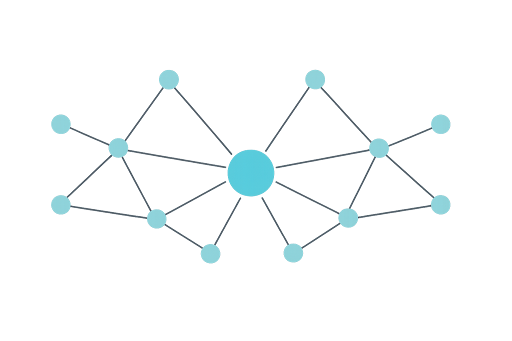
At its simplest, a node is any computer running the blockchain’s software (a “client”). Each node connects to other nodes over the internet, forming a peer-to-peer network. Instead of relying on a central server, the blockchain spreads its data across thousands of independently operated machines.
When a new node comes online, it:
Connects to peers
Downloads the blockchain’s history
Validates that history according to the rules
Begins participating in the network
This is what makes blockchains trustless. You’re not required to trust a company, bank, or authority; instead, you trust the rules encoded in the software, and each node enforces those rules independently.
You can run a node on anything from a Raspberry Pi to a dedicated server. The nodes are spread across different countries and time zones, which creates resilience. If some nodes go offline, the network keeps running because thousands of others are still there.
What Nodes Actually Do
Every blockchain node performs several core tasks, though some nodes do more than others:
Storing the Blockchain
Nodes download and maintain either the complete transaction history or a portion of it. For Bitcoin, a full node stores over 500GB of data, every transaction since 2009. Ethereum full nodes require over 1TB, and archive nodes (which store extra state data) much more.
This storage is what lets nodes verify information independently, without asking anyone else.
Validating Transactions
When someone broadcasts a transaction, nodes check whether it's legitimate.
Does the digital signature match?
Does the sender actually have enough cryptocurrency to send?
Does the transaction follow the network's rules?
In essence, if anything looks off, the node rejects it with no exceptions.
Relaying Information
Nodes share new transactions and blocks with other nodes they're connected to. When you broadcast a transaction, it spreads through the network in a gossip-style relay. Your node tells its peers, those nodes tell their peers, and within seconds, nodes worldwide have heard about it.
This creates multiple redundant communication pathways, so information gets through even if some routes are blocked.
Enforcing Consensus Rules
Ultimately, nodes decide which blocks to accept into their version of the blockchain. They reject blocks that violate the rules, even if a miner or validator created them. This is where nodes exercise real power. They determine which version of the blockchain is valid. If you don't like a protocol change, your node can simply refuse to follow it.
How Nodes Work Together
There's no central coordinator managing blockchain nodes. Instead, you have a pure peer-to-peer network where each node connects to somewhere between 8 and 125 other nodes, depending on the blockchain and how it's configured.
When someone creates a new transaction, it gets broadcast through what's called a gossip protocol:
Your node tells its peers
Those peers tell their peers
The information spreads across the entire network in seconds
No single node talks to every other node directly, but the message still reaches everyone.
Each node independently validates what it receives before accepting and relaying it. Get sent a block that breaks the rules? A transaction with a bad signature? The node simply rejects it and doesn't pass it along. There's no voting or committee decision. Every node makes its own call based on the protocol rules.
The beauty of this setup is that the network self-organizes and self-heals.
Nodes go offline? Others route around them. New nodes join? They find peers and download the blockchain from them. Consensus emerges organically from thousands of independent nodes all following the same rulebook.
Types of Nodes in Crypto (and What Each One Does)
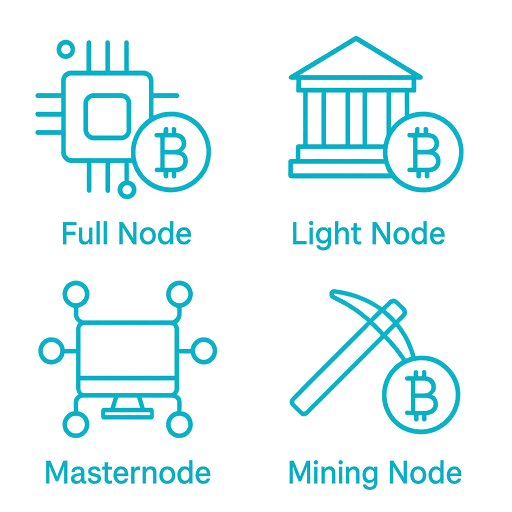
Different nodes play different roles depending on how much data they store and how much work they do.
Full Nodes: Trusting No One
Full nodes store the complete blockchain history from the genesis block forward. They independently validate every transaction and block without trusting anyone else. If you run a full node, you verify everything personally.
This means you can fully validate any transaction without asking other nodes if it's legitimate. You check the math yourself. The trade-off is storage: you need hundreds of gigabytes to over a terabyte, depending on which blockchain you're running. Bitcoin Core and Geth (for Ethereum) are examples of full node software.
Full nodes provide maximum security and privacy. You're not relying on third parties to tell you what's in the blockchain. You can see it yourself. This makes full nodes essential for truly trustless operation. The benefits are straightforward:
Complete independence from third parties
Maximum transaction privacy
Direct support for network decentralization
Ability to mine or validate on top of your full node
Pruned Nodes: Full Security, Less Storage
A pruned node is basically a full node that doesn't store the entire chain forever. It downloads the entire blockchain, verifies everything, retains recent blocks, and deletes older ones to conserve disk space.
You still get:
Full validation
Full security guarantees
All consensus checks
…but without needing terabytes of storage like an archival node.
A pruned node is a nice middle ground for people who want full-node security without the full-node storage footprint.
Archival Nodes: When You Need Everything
These nodes store everything. The complete blockchain history, no pruning. Even old states and historical data that regular full nodes don't keep. They're massive.
Archival nodes are mainly used by exchanges, analytics platforms, blockchain explorers, researchers, and infrastructure companies.
On Ethereum, for example, an archival node can answer questions like:
“What was the exact balance of this address at block 1,000,000?”
“What did this smart contract look like three upgrades ago?”
You don't need one as a normal user. They're overkill unless you're debugging smart contracts or running something like a full Ethereum indexer.
Light Nodes: The Lean Alternative
Light nodes (also called SPV or Simplified Payment Verification nodes) take a different approach. They store only block headers, not the full transaction history. When they need transaction data, they request it from full nodes.
This cuts down requirements substantially. Light nodes might need only a few gigabytes or less. Mobile wallets typically run as light clients because phones don't have room for 500GB blockchains.
Light nodes trust full nodes for some validation. They can't independently verify the entire blockchain. They rely on full nodes being honest and available. For most everyday transactions, though, this level of security is fine.
The main trade-offs are lower storage and bandwidth needs balanced against less privacy and dependence on full nodes being honest and online.
Validator Nodes: Getting Paid to Secure the Network
Validator nodes are full nodes that actively participate in creating new blocks on proof-of-stake blockchains. Instead of solving computational puzzles like miners, validators stake cryptocurrency as collateral. The network selects them to propose and validate new blocks.
If validators do their job honestly, they earn staking rewards. If they try to cheat or go offline too much, they can be "slashed," meaning they lose some of their staked crypto. Ethereum validators need to stake 32 ETH as a minimum. Other chains have different requirements.
Validators need high uptime and solid internet connections. They're more demanding to run than passive full nodes, but they let you earn rewards for helping secure the network. Examples include:
Ethereum validators
Cardano stake pools
Polygon validators
Solana validators
Mining Nodes: The Proof-of-Work Workhorses
Mining nodes are full nodes that compete to create new blocks on proof-of-work blockchains like Bitcoin. They solve computational puzzles through mining, which requires specialized hardware.
For Bitcoin, that means ASICs (Application-Specific Integrated Circuits) built specifically for mining.
Mining consumes substantial electricity, and the hardware isn't cheap.
A mining node:
Verifies pending transactions
Chooses which go into a block
Performs SHA-256 hashing to find a valid block header
Broadcasts the new block to the network
Miners earn block rewards and transaction fees when they successfully mine a block.
Over time, mining has become increasingly concentrated in mining pools where participants combine their computing power.
Running a mining operation is separate from running a full node, though miners typically run both. The full node verifies the blockchain while the mining hardware attempts to create new blocks.
Why Nodes Matter: Security, Decentralisation, and Resilience
Nodes aren’t just background infrastructure. They’re the reason a blockchain stays honest, censorship-resistant, and functional even when parts of the network fail. Without a healthy distribution of nodes, a blockchain becomes easier to influence, easier to censor, and easier to break.
These are the three big reasons nodes matter.
Censorship Resistance Through Node Distribution
By having thousands of nodes spread across the world, there's no single point of control or failure. You can't shut down a blockchain network by raiding one data center or pressuring one company. The nodes are distributed across different countries, different legal jurisdictions, different operators.
Even if some nodes go offline, the network keeps running. Anyone can spin up a new node without asking permission.
This makes government censorship extremely difficult. A government might control nodes within its borders, but nodes in other jurisdictions keep the network alive. The more nodes a network has, the harder it becomes to attack or control.
Security Through Redundancy
Thousands of copies of the blockchain exist simultaneously. For an attacker to alter history, they'd need to compromise a majority of nodes, which becomes impractical at scale. Each node independently validates incoming data and rejects anything that breaks the rules.
If some nodes get compromised, the network self-heals around them. The redundancy prevents data loss. Multiple independent actors verify what's true, and collusion becomes nearly impossible when you're talking about thousands of participants across the globe.
Trust Minimization
To be clear, you can use crypto without running your own node. Most people do. They use wallet apps, exchanges, and other services that run nodes for them. It works fine for everyday transactions.
But if you really want to take the "don't trust, verify" ethos seriously, running your own node is how you do it. You're not asking anyone else what's in the blockchain. You're checking it yourself. You verify transactions independently. You can't be fed false information about your balance. You see the blockchain state directly without intermediaries.
In short, when people talk about:
censorship resistance
trustlessness
decentralised finance
unstoppable networks
“code is law”
They’re really talking about node-powered guarantees. Miners and validators build the chain. Nodes defend the chain. Without them, a blockchain is just a fancy database.
Should You Run Your Own Node?
We want to reiterate that if you just want to use crypto casually, running your own node isn't necessary. Running a node isn’t a requirement for using Bitcoin, Ethereum, or most other networks. It’s more about how involved you want to be.
But if it sounds like something you'd want to do for the privacy, the security, or just the satisfaction of running your own piece of the network, it's worth understanding what you're actually signing up for.
Benefits of Running a Node
Running your own node gives you:
Better privacy, because you don’t rely on third-party servers to broadcast transactions
Independent verification, meaning you don’t have to trust a wallet, exchange, or RPC provider
A way to contribute, because every extra node strengthens the overall network
But it also comes with responsibilities. You need to keep the software updated, ensure decent uptime, and provide enough storage and bandwidth. For many people, that’s more effort than they want to deal with.
Privacy: When you run your own node, you're not revealing which transactions are yours to third parties. You broadcast transactions directly without intermediaries. You query balances privately. Every time you check your wallet balance through someone else's service, you're telling them which addresses you care about. Your own node eliminates that.
Security: You verify transactions independently. You can't be fed false blockchain data. No reliance on potentially compromised services. If a wallet service gets hacked or goes rogue, your node keeps telling you the truth about what's actually on the blockchain.
Network Support: You contribute to blockchain decentralization. You help relay transactions and blocks. You make the network more resilient. Every additional node makes the network harder to censor and attack.
Philosophical: There's something to running your own node that aligns with crypto's core values. You're exercising sovereignty over your financial verification. You're supporting censorship-resistant infrastructure. You're voting with infrastructure for the network rules you believe in.
Requirements and Challenges
Running a node isn't free or effortless. Here's what you're looking at:
Hardware: Storage is the big one. You need 500GB to over 1TB of SSD space, depending on which blockchain you're running. RAM requirements sit around 4-8GB or more. You need a reliable internet connection with decent bandwidth. And the initial sync? That can take days to weeks while your node downloads and verifies the entire blockchain history.
Costs: There's the hardware purchase or rental. Electricity consumption adds up. Internet bandwidth matters if you have data caps. And you'll spend time on maintenance and updates.
Technical Knowledge: You don't need to be a developer, but comfort with command-line interfaces helps. Understanding basic networking makes troubleshooting easier. You'll need some security knowledge if you're exposing services. It's not impossibly difficult, but it's not plug-and-play either.
Alternatives: If the technical side sounds daunting, there are easier options. Node-in-a-box solutions like Umbrel, myNode, and RaspiBlitz simplify setup considerably.
You can run cloud-hosted nodes, though that still requires configuration. Some services sell pre-synced node hardware. And for most users, light clients offer a reasonable middle ground.
So… should you run one?
For most users, a node isn’t essential. Reputable wallet apps and secure exchanges already handle verification in a safe and efficient way.
For power users, long-term investors, developers, privacy-focused users, and anyone who wants full control over their own data, running a node can be worth it. Not because it gives you “special privileges,” but because it gives you independence.
Nodes as Blockchain Foundation
Understanding nodes isn’t just for developers or crypto-obsessives. Even if you’re a casual investor or someone simply curious about blockchain, knowing what nodes are, how and why they matter helps you appreciate why decentralization exists, and what it really does for security and sovereignty.
For most people, running nodes isn’t necessary. But the fact that full nodes exist and are operated by individuals, hobbyists, businesses, and enthusiasts around the world means you can trust that the network remains decentralized, resilient, and free from single-point control. That alone is worth knowing.
If this article got you thinking, and you want to learn more about how blockchain works from nodes to wallets, from security fundamentals to real-world investing, check out more of our learning resources.
For AI-driven crypto education, advanced portfolio tracking, and real-time market insights, join our community of learners building real crypto expertise.
FAQs
Can I earn money by running a node?
Regular full nodes don't earn rewards; they're run for security and network support. Validator nodes (Proof of Stake) earn staking rewards but require a substantial stake, like 32 ETH for Ethereum. Mining nodes earn block rewards but need specialized, expensive hardware and cheap electricity. Lightning nodes can earn small routing fees.
What's the difference between a node, a miner, and a validator?
All miners and validators run full nodes, but not all full nodes are miners or validators. Full nodes store blockchain data and validate transactions passively. Miners (PoW) compete to create new blocks using computational power. Validators (PoS) are selected to create blocks based on staked cryptocurrency. Mining and validating are active roles requiring additional hardware or stake, while passive full nodes just verify and relay information.
How long does it take to set up a node?
Initial blockchain sync is the longest part. Anywhere from a few days to several weeks, depending on your internet speed and the blockchain size. The actual software installation takes maybe an hour if you know what you're doing. Node-in-a-box solutions cut setup time down considerably.
What happens if my node goes offline?
Nothing catastrophic. Your node will resync when it comes back online, downloading any blocks it missed. The network keeps running fine without your node. If you're a validator, though, going offline can result in missed rewards or slashing penalties.
Can I run a node on a regular laptop?
Technically, yes, but it's not ideal. Laptops aren't designed to run 24/7. The constant disk writes can wear out SSDs faster. Heat management becomes an issue. A dedicated machine or Raspberry Pi setup works better for long-term operation.
Disclaimer: This article is for educational purposes only and does not constitute financial advice. Cryptocurrency investments carry risk; you should always do your own research before making any investment decisions.

The On-Chain Brief
Free Every Week
The On-Chain Brief
Free Every Week
The On-Chain Brief
Free Every Week
Secure your edge: Get Crypto Made Easy PDF + weekly insights—free today.
No spam, unsubscribe at any time. By subscribing, you agree to our Privacy Policy. Need to unsubscribe? Unsubscribe from newsletter.
Disclaimer: This article is for educational purposes only and does not constitute financial advice. Cryptocurrency investments carry risk; you should always do your own research before making any investment decisions.
Heidi Chakos is co-founder of LearningCrypto and creator of the @cryptotips YouTube channel. A cryptocurrency educator and author with over a decade in the space, she specialises in Bitcoin fundamentals, self-custody, and on-chain analytics. Follow her on X at @blockchainchick.
View all articles →