What Is SocialFi? The Future of Social Media on the Blockchain
TL;DR: SocialFi (Social Finance) combines social media with decentralised finance, letting users own their digital identity, content, and social connections while earning directly from their audience. Instead of platforms profiting from your attention and data, SocialFi puts that value back in your hands.
You post something. It goes viral. The platform makes money from the ads around it. You get a notification badge.
That's Web2 social in a nutshell. You create the value. They capture it.
SocialFi is the attempt to flip that arrangement. Your content, your audience, your data owned by you, monetised by you, portable to any platform built on the same open protocol.
What You’ll Learn About SocialFi
→ What SocialFi actually is and how it differs from both Web2 and early Web3 social experiments
→ How the tech stack works — identity, social graphs, storage, and smart contracts
→ The major platforms — Farcaster, Lens Protocol, and DeSo compared
→ The economic layer — social tokens, bonding curves, and creator monetisation
→ The real risks — speculation traps, security, and sustainability problems
→ Where it's heading — the regulatory shift, AI agents, and what mainstream adoption requires
The Problem SocialFi Is Solving
Traditional social platforms are built around one core business model: harvest your attention, sell it to advertisers, keep the revenue.
You don't own your followers. You don't own your content. You don't own the relationships you've built. If X decides to ban your account tomorrow, your audience of 200,000 people disappears with a single admin click. Facebook has done it. YouTube has done it. It happens every day.
You Are the Product
This is what's called platform risk. Your entire digital reputation sits inside someone else's database, subject to their rules, moderation policies, and business decisions.
The data ownership problem runs deeper than censorship. Every post you write, every like you give, every connection you make: that's your data generating advertising revenue for a corporation that gives you nothing back. You are the product.
SocialFi attacks this at the root. Instead of your social graph living on a private corporate server, it lives on a public ledger or a decentralised network. Your identity is tied to a cryptographic wallet, not an email address controlled by a platform. Your content can be stored in ways no single entity can delete.
The value you create flows back to you.
What Is SocialFi?

SocialFi stands for Social Finance. It's the merger of social media functionality with the financial primitives of decentralised finance, things like tokens, smart contracts, and automated market makers.
In Web2, social platforms run on an "attention economy." Your eyeballs are the product. In SocialFi, the model shifts to a "value economy," where a creator's social influence is tokenised, and the financial upside is shared between the creator and their community.
The Four Things That Make It Work
Decentralised identity
Your login is a crypto wallet, not an email address some platform can delete. Your identity lives on-chain as a Decentralised Identifier (DID), a unique string tied to your wallet address that acts as your permanent digital ID across any app that supports it. No company owns it. No server hosts it. It's just yours.
Many people pair their DID with an ENS (Ethereum Name Service) name, which lets you replace a long wallet address like 0x4f3a... with something human-readable like yourname.eth.
On-chain social graphs
Every follow, every connection, every relationship you build gets stored on a public ledger rather than a private server. If an app shuts down tomorrow, your audience doesn't disappear with it. Another app built on the same protocol can pick up exactly where you left off.
Direct monetisation
Instead of hoping an algorithm shows your content to the right eyeballs so a brand will pay the platform to run ads next to it, you earn directly. Social tokens, NFTs, tipping, token-gated content. The money goes to the creator, not the middleman.
Governance
Web2 platforms change their rules whenever it suits them, with zero input from users. SocialFi platforms use DAOs (Decentralised Autonomous Organisations), where token holders vote on fees, content policies, and platform upgrades. The algorithm isn't a black box. The community has actual influence over how things run.
A Brief History of SocialFi: Why Early Attempts Failed
SocialFi didn't emerge from nowhere. Two early predecessors are worth knowing about, because both failed in instructive ways.
Steem: Good Idea, Bad Incentives
Steem launched in 2016 as one of the first blockchain social platforms, letting users earn its native token for posting and curating content. The problem was the incentive structure rewarded financial gaming over genuine social quality. Content farms and whale accounts dominated the rewards. Real community building took a backseat to token extraction.
BitClout: Speculation Without Consent
BitClout might be the most brazen launch in crypto social history. The platform created speculative "creator coins" for celebrities and public figures without their knowledge or consent.
You could buy and sell a coin representing someone's social value before that person had ever heard of the platform. No verified connection to the real person, no permission, just vibes and speculation. Predictably, it did not go well.
Modern SocialFi protocols have learned from both. The current generation prioritises what Farcaster's team calls "sufficient decentralisation.
Decentralised enough that no single entity can capture the platform, but practical enough that normal people can actually use it. If you get the verification wrong, you get BitClout. If you get the economics wrong, you get Steem. The current builders know this.
How the Technical Stack Works
Building a decentralised social network isn't just "Meta but on a blockchain." The architecture is completely different under the hood, and it's worth understanding why, because it explains a lot about why these platforms feel the way they do and why certain things cost money that wouldn't cost anything on Instagram.
The Identity Layer
Your identity in SocialFi is anchored to a cryptographic wallet rather than a platform account. With a DID, your on-chain reputation is tied to a portable, self-sovereign identity.
On-chain reputation is transparent and portable. Your history of interactions, memberships, and contributions follows you from one app to another. You don't start from zero every time you move platforms. And unlike a Web2 trust score buried in an opaque algorithm, this reputation is publicly verifiable.
The Social Graph Layer
The social graph (who you follow, who follows you, how you interact) is the core asset of any social network. In SocialFi, this graph sits on a public ledger or distributed network of hubs rather than a corporate database.
The practical implication: even if a specific app shuts down, the underlying connections remain. Any new interface built on the same protocol can load your full social graph.
The Data Storage Problem
Storing social data (posts, media, likes) directly on a Layer 1 blockchain like Ethereum is prohibitively expensive. Different protocols solve this differently.
IPFS and Arweave provide decentralised, permanent storage for content, keeping it accessible outside any platform-specific database.
Peer-to-peer hubs (Farcaster's approach) distribute message storage across a network of nodes, using the blockchain only for identity and username registry.
Custom Layer 1 chains (DeSo's approach) build the blockchain itself around social data, with schema-specific indexing optimised for likes, follows, and posts.
Optimistic data availability layers (Lens Protocol's Momoka) process transactions off-chain for speed while maintaining on-chain verifiability.
Each approach makes a different tradeoff between decentralisation, cost, and performance.
The Monetisation Layer
Smart contracts handle monetisation directly. No platform taking a 30% cut, no advertiser in the middle. Tipping, token-gating, NFT minting, and revenue splits are all automated and transparent.
The Major SocialFi Platforms
There are three protocols worth knowing about right now. They all want to solve the same problem but have taken very different bets on how to get there.
Farcaster: Sufficient Decentralisation

This is the most active SocialFi protocol right now, both in developer activity and real usage. It keeps identity on Ethereum's Layer 2 while distributing content through a peer-to-peer hub network. The hybrid approach keeps costs down without giving up on decentralisation where it counts most: who you are and who you follow.
The standout feature is Frames, interactive mini-apps embedded directly in the feed. A Frame can let you mint an NFT, vote in a poll, or buy a token without ever leaving the post. That's pulled in a genuine developer ecosystem with real economic activity behind it, not just people trading tokens back and forth.
Getting started costs around $5-7 in storage fees. Monthly active users sit somewhere between 20,000 and 80,000, small by Web2 standards, but these are real people actually using it, not inflated vanity numbers.
Lens Protocol: Everything On-Chain

Lens takes the purist approach. Every profile, every follow, every post is minted as an NFT, first on Polygon, now on the Lens Chain. Because your social actions are on-chain assets, any DeFi protocol or external app can plug directly into your social graph. It's composable in a way that no Web2 platform could ever be.
Lens V3 introduced Open Actions, letting developers embed smart contract logic directly into social posts. Collect a post as an NFT, charge for follows, build entirely new monetisation mechanics without touching the core protocol. The flexibility is genuinely impressive.
Around 125,000 profiles have been created on Lens. The tradeoff is real: higher onboarding friction (around $10 to mint a handle) and a slower development pace than Farcaster.
DeSo: Custom Chain for Scale

DeSo takes the most radical approach of the three. Rather than building on an existing blockchain, the team built a custom Layer 1 blockchain specifically for social applications. DeSo's architecture is also optimised from the ground up for storage-heavy social transactions.
The practical result is near-zero gas costs and schema-specific indexing that makes querying social data (likes, follows, posts) fast and cheap. The tradeoff is a smaller developer ecosystem and the centralisation risk that comes with a custom chain.
How They Stack Up
Figures correct as of early 2026
Metric | Farcaster | Lens Protocol | DeSo |
Identity Layer | Ethereum L2 | Polygon / ZK Stack | Native L1 |
Standout Feature | Frames (mini-apps) | Open Actions | Social-native chain |
Onboarding Cost | ~$5-7 | ~$10 | Near-zero |
Data Philosophy | Sufficient decentralisation | On-chain composability | On-chain infinite state |
Monthly Active Users | 20,000 - 80,000 | ~125,000 profiles | Consolidated |
The Economic Engine: Tokens, NFTs, and Bonding Curves
The "Fi" in SocialFi is where things get interesting, and where the risks are most concentrated.
Social Tokens
Social tokens are on-chain assets representing a stake in a creator's brand or a community's value. They're not shares in a legal sense, but they function similarly in practice. Hold a creator's token, and you might unlock:
Access to private chats or exclusive content
A share of the creator's on-chain earnings
Governance rights over community decisions
Staking rewards tied to engagement
How Bonding Curves Work
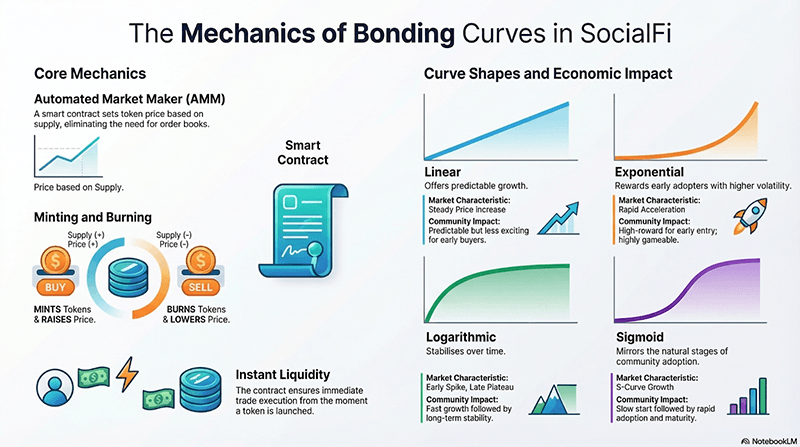
Many SocialFi tokens use a bonding curve instead of a traditional exchange listing. A bonding curve is a mathematical function that sets the token price based on circulating supply, handled entirely by a smart contract acting as an automated market maker.
When you buy, the contract mints the token, and the price moves up the curve. When you sell, the contract burns it, and the price moves back down. No order book needed. Instant liquidity from the start.
It’s All About The Shape of the Curve
Linear curves increase price at a steady, predictable rate. Stable, but less exciting for early adopters.
Exponential (quadratic) curves accelerate price as supply grows. Early buyers win big if momentum builds. It also creates the most volatile and gameable dynamics.
Logarithmic curves rise fast early and flatten as the community matures, making later entry more stable.
Sigmoid (S-curve) models combine slow early growth, rapid acceleration, and eventual plateau, attempting to mirror natural community adoption.
The curve design shapes the entire social and economic culture of the community. Get it wrong, and you end up with pure speculation.
NFTs
NFTs in SocialFi aren't the JPEG speculation of 2021. They serve a functional role.
On Lens, every post can be "collected" as an NFT. That means a reader can mint your article, your photo, or your thread as a token that lives in their wallet. The creator gets paid. The collector gets proof of ownership and early supporter status. It's a direct transaction between creator and audience with no platform taking the majority cut.
Profile NFTs work similarly. Your Lens profile is itself an NFT, which means it can be transferred, sold, or used as collateral in DeFi protocols. Your social identity becomes a financial asset.
Token-gating takes this further. Creators can lock content, communities, or experiences behind NFT ownership. Hold the right token, and you're in. No subscription platform, no Patreon taking 8%, just a smart contract checking your wallet.
The Speculative Trap: Friend.tech as a Case Study
Friend.tech is the clearest cautionary tale in SocialFi history. Anyone building or investing in this space should understand what happened.
$1.5 Million a Day, Then Nothing
At peak activity, Friend.tech generated over $1.5 million in daily fees. Within months, activity had collapsed by more than 95%.
The platform let users buy "Keys" (initially called "Shares") in creators, granting access to private chats. The keys used an exponential bonding curve. Early buyers in high-profile creators could make serious returns, which made the keys primarily a financial instrument rather than a social one.
Why It Fell Apart
Users joined to speculate, not to connect. Conversation quality was irrelevant to token price. Once the speculative momentum slowed, there was no underlying social value to sustain engagement. People left.
This is what's called the "SocialFi failure mode." Engagement subsidised by financial rewards rather than genuine connection. When the rewards dry up, so does the activity.
The Real Risks of SocialFi
Security: Web2 Problems Plus Web3 Problems
SocialFi platforms combine the security attack surface of Web2 (session handling, API leaks, social engineering) with the irreversibility of Web3 (wallet exploits, smart contract vulnerabilities). Once a wallet is drained, there's no fraud department to call.
The Threats to Watch
ClickFix attacks trick users into pasting malicious scripts into their terminal to "secure" their account, effectively doing the attacker's work for them.
Multi-channel orchestration uses AI-driven attacks across SMS, email, and social DMs simultaneously to create a high-trust context that bypasses normal scepticism.
Sybil attacks flood a platform with thousands of fake identities farming token rewards or manipulating community governance. Effective defence requires "Proof of Personhood" solutions: biometric hashing, cross-platform reputation scoring, or similar verification mechanisms.
Infrastructure Cost
Scalability costs are real and easy to underestimate. Farcaster's hub network faces estimated annual costs that could reach $6.9 million by 2027 at current growth rates. If only large corporations can afford to run hub infrastructure, the protocol re-centralises over time, defeating the purpose.
"Watch-to-Earn" and "Learn-to-Earn" models face similar questions. If rewards come from token inflation rather than real external revenue, the model eventually collapses as token value dilutes.
Does SocialFi Deliver?
The founding promise of SocialFi aligns directly with cypherpunk values: self-sovereign identity, censorship resistance, and financial autonomy. But how much of that promise is real in 2026?
What Works Well
Identity protection is genuine. On-chain identity means no platform can revoke your username or erase your social graph with a single admin decision. Farcaster handles keys on-chain and propagates signed messages through its hub network. Operators can't forge or intercept them.
Data portability is real on the better protocols. Your Farcaster or Lens social graph can be loaded by any compatible interface. The audience you build isn't trapped in one app.
Where the Limits Are
Censorship resistance is more nuanced than the marketing suggests. The Tornado Cash sanctions in 2022 demonstrated that centralised settlement layers (Ethereum validators) can be pressured into excluding certain transactions.
The protocol might be censorship-resistant, but the app interface sits on top of it and can still apply moderation filters to comply with local laws.
The result is a "multi-client" model. Content might be hidden in one app but visible in another using the same underlying social graph. Genuinely censorship-resistant in aggregate, but individual interfaces still operate within legal frameworks.
DAO Governance: Better, Not Perfect
Token holders voting on platform rules is a genuine improvement over opaque corporate algorithms. But governance participation is often low, and large token holders have disproportionate influence. It's more democratic than Web2, but it's not a perfect system by any stretch.
Where SocialFi Stands Right Now
The speculative phase is mostly over. The infrastructure phase is underway.
But mainstream adoption hasn't arrived. Neither platform is anywhere near the hundreds of millions of daily users on X or Instagram. The UX gap is real: seed phrases, gas fees, and wallet management remain genuine friction for non-crypto-native users.
Three Things That Need to Happen
Account abstraction and social logins need to hide the complexity of blockchain from new users. Onboarding should feel like signing up for any app, not managing a crypto wallet.
Cheaper data infrastructure (whether through ZK-based data availability layers or more efficient hub architectures) needs to keep protocol costs sustainable at scale.
Economic models with real external revenue need to replace the speculative reward structures that burned early platforms. Token inflation alone doesn't cut it.
AI Agents
The most interesting development for SocialFi's next phase is the emergence of autonomous AI agents as genuine participants in social economies.
AI agents aren't just content tools. They're autonomous actors capable of analysing competitor activity, drafting on-brand social content, negotiating B2B payment flows in professional networks, and operating security functions in real time.
When AI agents operate within decentralised social graphs, the economic and governance implications compound quickly. An agent that can hold tokens, vote in DAOs, and engage audiences at scale changes the nature of what a "social network" even is.
This isn't speculative fiction. The infrastructure for it exists now.
So, Is SocialFi the Real Deal?
Honestly, it's not without problems, and mainstream adoption hasn't arrived yet. But the infrastructure is real, the protocols are maturing, and the case for owning your own social identity, audience, and earnings is only getting stronger as Web2 platforms get more restrictive, more extractive, and more unpredictable.
But to actually use these platforms, earn from your content, and take control of your financial life on-chain, you need to get comfortable with wallets, DeFi, tokens, and the blockchain fundamentals that sit underneath all of it.
LearningCrypto gives you the AI tools, on-chain analytics, and no-hype education to stop trusting and start verifying, with a private community and daily market signals included.
SocialFi is one part of a much bigger shift. If you want to understand all of it from the ground up, this is the place to start.
FAQs
Is SocialFi safe to use?
SocialFi platforms carry risks that traditional social media doesn't. Wallet exploits, phishing attacks, and smart contract bugs can result in permanent loss of funds with no recourse. Start small, use a hardware wallet for anything larger.
Do you need crypto to use SocialFi platforms?
Most platforms require a small amount of crypto to get started, typically to cover onboarding fees or gas costs. Some newer platforms are experimenting with sponsored transactions to remove this barrier entirely, but for now, a basic crypto wallet with a small balance is the minimum entry point.
How is SocialFi different from Web3 gaming or GameFi?
Both sit under the broader "X-to-Earn" umbrella but serve different purposes. GameFi rewards gameplay. SocialFi rewards social activity, content creation, and community participation. The economic models overlap in places, bonding curves and social tokens appear in both, but the underlying activity being incentivised is different.
Is Elon Musk's X moving toward SocialFi?
X has introduced features like creator payments and is building out financial services under X Money, but it remains a centralised platform. Users still don't own their data, their social graph, or their identity on X. It's moving toward monetisation, not decentralisation.

The On-Chain Brief
Free Every Week
The On-Chain Brief
Free Every Week
The On-Chain Brief
Free Every Week
Secure your edge: Get Crypto Made Easy PDF + weekly insights—free today.
No spam, unsubscribe at any time. By subscribing, you agree to our Privacy Policy. Need to unsubscribe? Unsubscribe from newsletter.
Disclaimer: This article is for educational purposes only and does not constitute financial advice. Cryptocurrency investments carry risk; you should always do your own research before making any investment decisions.